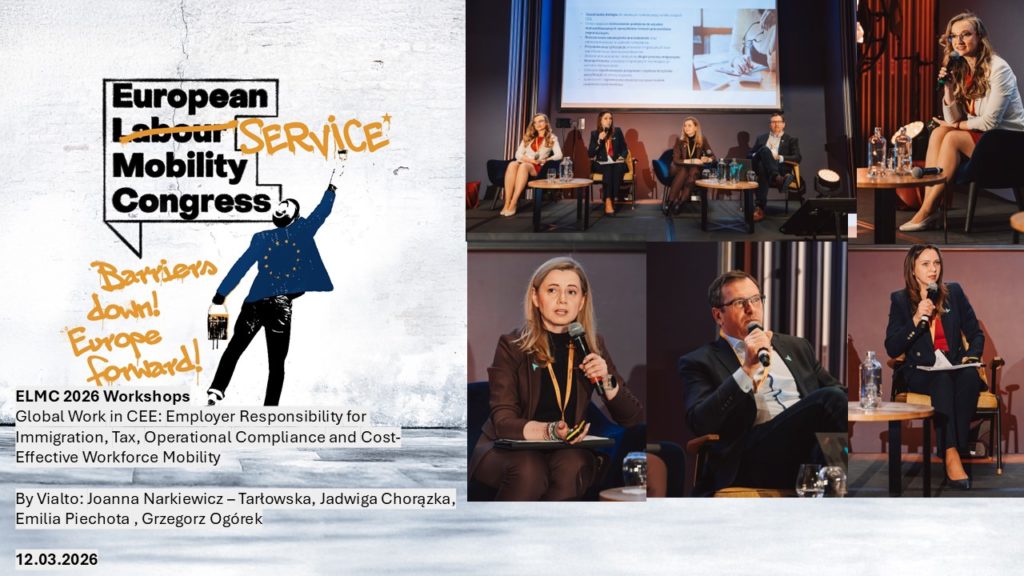
The growing complexity of workforce mobility across Central and Eastern Europe was the focus of one of the final workshops held during ELMC 2026.
During the session “Global Work in CEE: Employer Responsibility for Immigration, Tax, Operational Compliance and Cost-Effective Workforce Mobility”, Joanna Narkiewicz-Tarłowska, Jadwiga Chorążka, Emilia Piechota and Grzegorz Ogórek from Vialto examined the practical challenges faced by employers managing international workforces across multiple jurisdictions.
The workshop explored how the rapid development of remote work, cross-border employment models and increasing workforce mobility are creating new legal, tax and operational obligations for employers. Particular attention was given to the growing responsibility of employers in managing immigration processes, tax compliance, social security coordination and workforce planning.
Participants discussed a number of practical issues, including:
- employment of foreign nationals across CEE countries,
- employer liability in immigration and work authorisation processes,
- tax and payroll obligations linked to cross-border work,
- permanent establishment (PE) risks,
- coordination of social security systems,
- differences in administrative practices between countries,
- financial consequences of non-compliance.
A key message emerging from the workshop was that workforce mobility can no longer be treated as a purely HR or immigration matter. Employers increasingly need integrated processes combining legal, tax, operational and compliance perspectives in order to manage risks effectively and support sustainable international growth.
The session provided participants with practical recommendations on how to structure mobility processes, allocate responsibilities and build compliance frameworks capable of supporting increasingly flexible workforce models.
📸 A few moments from the workshop can be found in the gallery below.