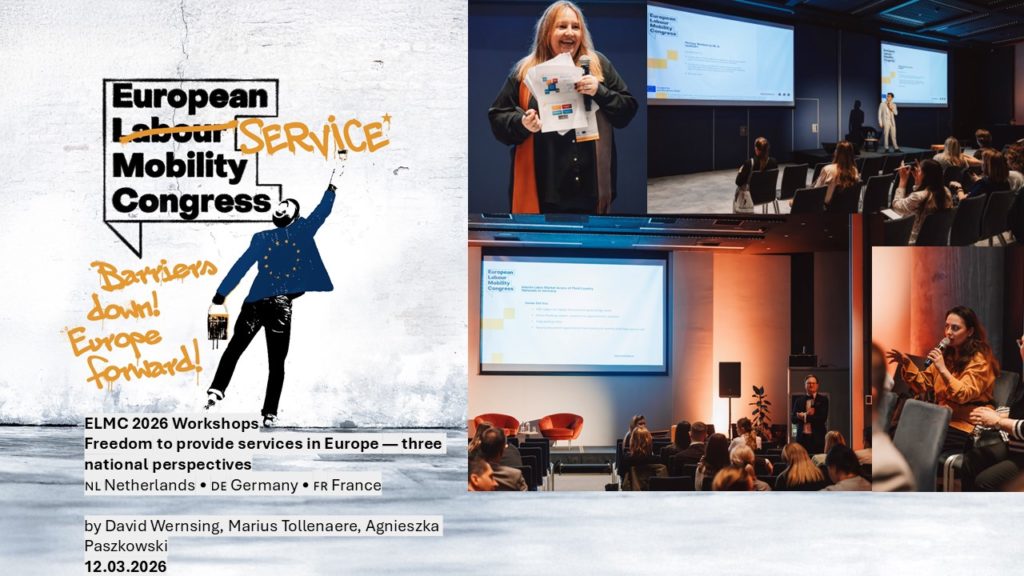

One of the recurring themes throughout the workshop part of ELMC2026 was the growing divergence between the formal framework of the EU Single Market and the practical realities faced by companies providing services across borders.
Three workshops dedicated to the Netherlands, Germany and France offered participants a comparative overview of current legal, compliance and enforcement developments affecting intra-EU service provision in practice.
Netherlands – compliance beyond formal notification
David Wernsing discussed the Dutch reporting system, documentation obligations and inspection practice related to the posting of workers. Particular attention was paid to the growing distinction between formal notification requirements and actual compliance expectations in practice.
The workshop also addressed the posting of third-country nationals to the Netherlands, practical inspection risks and upcoming regulatory developments affecting foreign service providers operating on the Dutch market.
Germany – enforcement, immigration and Vander Elst challenges
Marius Tollenaere examined the increasingly complex interaction between German posting regulations, immigration requirements and enforcement practice under the German Posted Workers Act (AEntG).
The session also explored the European Commission’s critical perspective on the German Vander Elst practice, the practical limits of the freedom to provide services in Germany and the growing importance of structuring cross-border operations in a legally robust and commercially sustainable manner.
Particular focus was placed on the posting of non-EU nationals and on the practical challenges faced by companies operating in an increasingly demanding regulatory environment.
France – labour law, taxation and conflicting administrative interpretations
Agnieszka Paszkowski analysed the provision of services in France from the employer’s perspective, focusing on labour law obligations, social security coordination and tax implications related to cross-border employment.
The workshop also highlighted practical difficulties resulting from diverging interpretations adopted by French tax authorities and social security institutions, as well as legal uncertainties surrounding the posting of third-country nationals to France.
Increasing complexity of national enforcement systems
A common conclusion emerged from all three workshops: the practical challenges faced by service providers increasingly result not from the absence of EU rules, but from the growing complexity of national enforcement systems, administrative practices and compliance expectations across Member States.
The sessions demonstrated that while the legal framework of the freedom to provide services formally remains common across the European Union, the practical conditions for operating across borders are becoming increasingly fragmented and difficult to navigate for employers and mobility professionals alike.